
A Light in the Valley: How PJ Cardona’s Mission is Changing Local Health and Healing


What began as a NASA discovery for space exploration has become a cornerstone of modern recovery here in the Valley. Certified light therapist PJ Cardona is on a mission to bring this medical-grade technology into every Arizona home, bridging the gap between clinical VA treatments and everyday wellness for athletes and families alike.
I think I heard the “pop” before I felt the pain, but it doesn’t really matter. In the blink of an eye, I went from avid recreational pickleball player to hobbling couch potato with the flick of a routine cross-court volley.
“You’ve probably pulled a calf muscle,” my friends told me as they helped me to the sidelines. “Don’t bother going to the ER unless it doesn’t get better in a few days.”
After they drove me home and made sure I was comfortable, I knew my next order of business was to call my good friend PJ Cardona of Lights and Health and rent one of her red light therapy home systems.
What is Red Light Therapy: From NASA to the Pickleball Court
I’d learned about the healing properties of red light therapy from PJ during one of her informational webinars.
“NASA actually discovered its benefits,” she explained. “They found out that the human body responds well to certain wave lengths. Beautiful things happen to human cellular structures when they’re exposed to the right wavelengths. It enables your body to work like it did when we were 20.”
And while that sounds like something directly from a sci-fi movie, the science is actually grounded in the way we produce energy. Think of Red Light Therapy (RLT) as a way to give your body’s cells a "battery boost."
Just like plants use sunlight to create energy through photosynthesis, our bodies can absorb specific wavelengths of red and near-infrared light.
And while a daily dose of Arizona sunshine is good for human bodies, too, we know that too much sun comes with a price. PJ pointed out that while the sun is a 'broad spectrum' of light, RLT is a surgical strike. It gives you healing wavelengths—all the good stuff—without the UV rays that cause sun damage and aging—none of the bad stuff. It’s the cellular nutrition of the sun, delivered with the precision of a laser.
How Red Light Therapy Works: A Simple Guide to Cellular Energy
Inside almost every cell in your body, you have tiny power plants called mitochondria. Their job is to create energy. Sometimes, due to stress, age, or injury, these power plants get a little sluggish.
When you shine red light on your skin:
The light travels deep into the tissue.
Your mitochondria soak it up like a sponge.
This kickstarts the production of ATP (adenosine triphosphate), which is basically the "fuel" your cells use to function, repair themselves, and stay healthy.
Top Benefits of Red Light Therapy: Neuropathy, Muscle Recovery and More
Since RLT is all about cellular energy and repair, the benefits are pretty broad. It’s like a Swiss Army knife for wellness:
● Skin Rejuvenation: It can help boost collagen, which smooths out fine lines and gives you that "glow."
● Muscle Recovery: Athletes love it for reducing soreness after a tough workout.
● Wound Healing: It helps the body knit itself back together faster by reducing inflammation.
● Pain Relief: It’s often used to ease the nagging ache of joints or chronic inflammation.
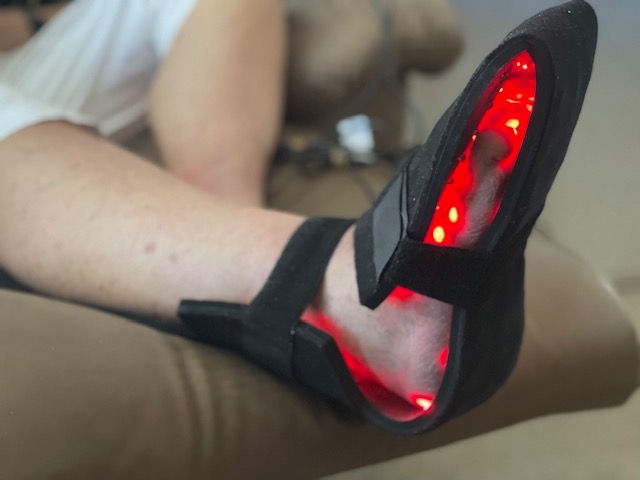
We purchased one of PJ’s InLight therapy systems for my mom a few years ago to help manage her neuropathy.
And while it hasn’t cured the nerve damage, she says daily use relieves the aches and pains she feels in her legs and feet, especially when she’s having a bad day.
PJ tells a similar story about an older gentleman from Rio Verde who has been suffering from the painful remnants of an accident he had in his 20s.
“I sent him home with a rental system,” she remembers. “He returned after two weeks walking a little taller. He said his pain had gone from an 8 (on a 10 point scale) to a 3.”
In her more than 12 years of business, PJ has accumulated a lot of stories like these, from a variety of people of all ages, all suffering from a wide expanse of aches and pains.
Red Light Therapy for Veterans: PJ’s Mission for Advanced Healing
The veteran community is perhaps the ultimate example of this 'Swiss Army knife' versatility, as service members often deal with a complex overlap of chronic pain, nerve damage, and recovery needs. This is where the science meets the street. PJ has been working directly with the Phoenix VA for the past three years, applying these protocols to the multi-layered injuries our local veterans face. For her, seeing this technology solve real-world problems for our heroes shifted the work from a clinical interest to a personal mission, something she describes as “exciting, worthwhile… and difficult.”
“I’m excited that the VA is starting to recognize light therapy,” she said. “It’s massively beneficial for this group of people because of their chronic pain due to amputations and injuries as well as their PTSD. I want to make it easier for our vets to have this therapy at home so they can get relief.”
Is Red Light Therapy Covered by Insurance? Understanding the Hurdles
The irony is that while the VA and an increasing majority of the medical community recognize the value of this technology for their patients, the broader insurance industry is still catching up.
When I asked PJ about coverage, she was honest: “It’s going to take time, but I’m seeing movement,” she said with optimism.
Currently, we are in a bit of a transition period. While recent breakthroughs—like the 2025 CPT code for retinal light therapy—show that the medical establishment is paying attention, many insurers still classify RLT for pain or neuropathy as 'investigational.' It’s a frustrating gap between what the science proves and what the paperwork allows. But as more veterans find relief and more clinical data hits the desks of policyholders, the needle is starting to shift.
How to Avoid Red Light Therapy Scams: Buying Certified Devices
If you find yourself thinking about the ways Red Light Therapy could improve your own health or recovery, you’re certainly not alone. The market is expanding rapidly, and the convenience of at-home treatment is a massive draw.

But buyer beware. Because this technology has become so popular, the internet is flooded with 'budget' devices that look the part but lack the power to actually perform. To ensure you’re investing in your health and not just a fancy desk lamp, PJ suggests looking for these four critical markers of quality:
Check for FDA "Clearance" (Not just "Registered")
This is the most common trick in the book. A company can be FDA Registered just by paying a fee and filling out a form—it doesn't mean their device actually works. You want to look for FDA Cleared. This means the specific device has been reviewed for safety and efficacy and is legally recognized as a medical tool.
The Power of "Irradiance" (and proximity)
Irradiance is the technical term for how much light energy actually reaches your skin.
The Misconception: Many people think you can simply stand a few feet away from a light panel to get results.
The Reality: PJ notes that for true healing, the light needs to be directly against or very close to the skin. Because light intensity weakens rapidly as it travels through the air, distance is the enemy of dosage. If you’re not close enough, your cells aren't getting that "battery boost" they need to repair. Look for devices designed for close-contact use to ensure the energy actually penetrates the tissue.
Wavelength Precision
Our cells only respond to a very specific range of light. You want to see two specific numbers: 660nm (for skin and surface healing) and 850nm (for deep muscle and nerve repair). If a company can’t provide third-party testing proving their lights hit these exact marks, keep moving.
Look for Board Certification
In a field that feels like "just turning on a light," true expertise is found in the training. A Certified Light Therapist (CLT) like PJ has gone through rigorous education—often through organizations like the Board of Photobiomodulation—to understand the biological interaction between light and human tissue.
What goes into PJ's certification?
● Dosimetry: Understanding the exact amount of light energy (joules) required for specific conditions. For example, treating surface skin requires a completely different "dose" than reaching deep-seated neuropathy in the feet.
● Safety Protocols: Knowledge of contraindications (when not to use light) and eye safety.
● Clinical Application: Staying current on the latest peer-reviewed research to ensure the protocols being used are the ones proven to work in clinical settings like the VA.
The Takeaway: When you work with a certified professional, you aren't just buying a device; you’re gaining an advocate who knows how to "tune" the therapy to your body’s specific needs.
Beyond the Clinic: PJ’s Vision for a Healthier Community
After twelve years in the field, PJ’s perspective has shifted from "if" this technology works to "how" we can get it into more hands. When I asked her about the future of light therapy and the slow movement of insurance coverage, her outlook was one of patient optimism:
"It will take time, but the movement is beautiful," she told me. "In my twelve years, I’ve seen it come so far. Now, it’s a movement of people talking to people—friends and family just wanting each other to feel better."
For PJ, the ultimate goal isn't just clinic-based care; it’s a system in every home. Red light therapy is a cumulative science—it builds on itself over time. It’s the difference between treating a condition only when you can find the time to make an appointment versus keeping your body at an "elevated level" every single day.
In case you were wondering, I was back on the pickleball court within 2 weeks and, as you might guess, taking measures to prevent another muscle pull. But if it does happen again, I’ll most definitely use red light therapy to help me heal.
Whether you’re recovering from a pickleball injury like I was, or managing something as chronic as my mom’s neuropathy, the message is clear: our bodies are designed to heal. Sometimes, they just need the right light to show them the way.
Contact PJ at Lights and Health to find out more about red light therapy and to claim your complimentary therapy session: pj@lightsandhealth.com or 630.624.6579.



Comments